 Application of Hardfacing Wear Plates in Ports

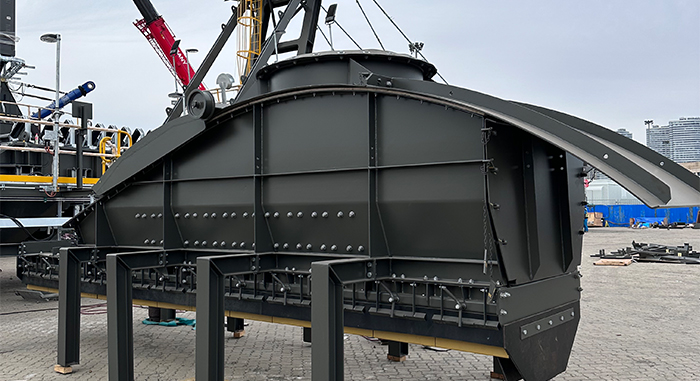
As a key vulnerable component at the furnace top, the blast furnace distributing chute directly affects the smooth operation of the blast furnace and maintenance costs. Its failure mainly stems from four major working condition issues: high-drop impact of furnace materials, lining wear caused by sliding materials, high-temperature burnout and cavitation erosion of the outer shell, and weld cracking, bolt shearing and matrix tearing induced by thermal stress.
Structural optimization and reasonable material selection are the two core approaches to improve the reliability and service life of the distributing chute.
Common distributing chutes are divided into material accumulation type and smooth surface type. Adopting a “material-on-material wear” structure, the material accumulation type buffers material flow impact through internal material accumulation and avoids direct scouring of the chute body by furnace materials, greatly reducing impact wear. It also optimizes the elliptical distribution phenomenon, featuring excellent impact resistance and long service life. It can achieve a service life of more than 36 months for a 2500m³ blast furnace, with the disadvantages of complex manufacturing process and heavy self-weight.
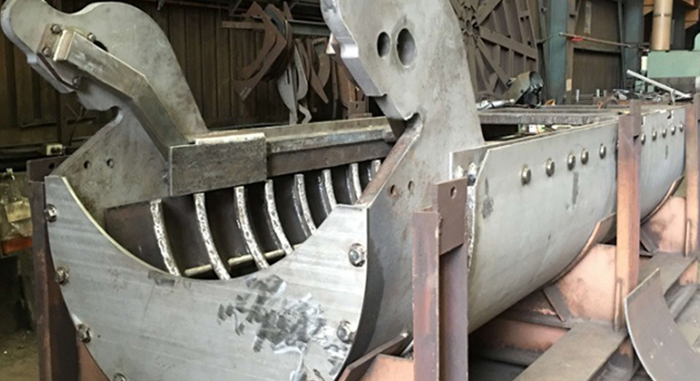
The smooth surface type includes assembled and overlay welded types with more convenient maintenance. The assembled type is equipped with detachable and position-swappable liners; the matrix can be used for a long term with only worn parts needing replacement. The overlay welded type allows targeted repair by overlay welding, delivering higher cost performance. Both structures require a smooth outlet section to ensure stable and orderly discharge of furnace materials.
In terms of material selection, conventional heat-resistant steel can meet the high-temperature resistance and strength requirements of the chute matrix, and external refractory protection can prevent burnout and cavitation erosion. The core industry challenge lies in wear-resistant materials: there is an inherent contradiction between hardness and toughness for conventional wear-resistant materials — higher hardness corresponds to poorer toughness, so material optimization alone cannot eliminate chute wear failure. Currently, cast, overlay welded and sintered cemented carbides are widely used, which need to be matched with structural design for optimal performance.
Summary: For heavy-duty working conditions, the material accumulation chute is preferred for long-term anti-impact service; for conventional working conditions, the assembled smooth surface chute is adopted to reduce operation and maintenance costs. Matching with suitable cemented carbide wear-resistant materials can effectively reduce chute failure and cut down shutdown and maintenance frequency.

With a leading R&D team, we continuously break through technological barriers, improve products, and develop more professional wear-resistant solutions to make our products more durable. Huisen constantly strives to meet the wear and tear requirements of various working conditions!


Follow Us
Copyright © 2025 Chromium Carbide Overlay Wear Plate & Wear Pipe Manufacturer & Welding Wire | HISAN All rights reserved
 Analysis on Failure Causes and Countermeasures of Blast Furnace Distributing Chute